
When the Sirens Go Off,
Be Underground.
Storms are the reason people say out loud. The real reason is simpler: systems fail. The grid goes down and stays down. Shelves empty. The help that is supposed to come takes days, and some nights it does not come at all. When that night comes, where does your family go?
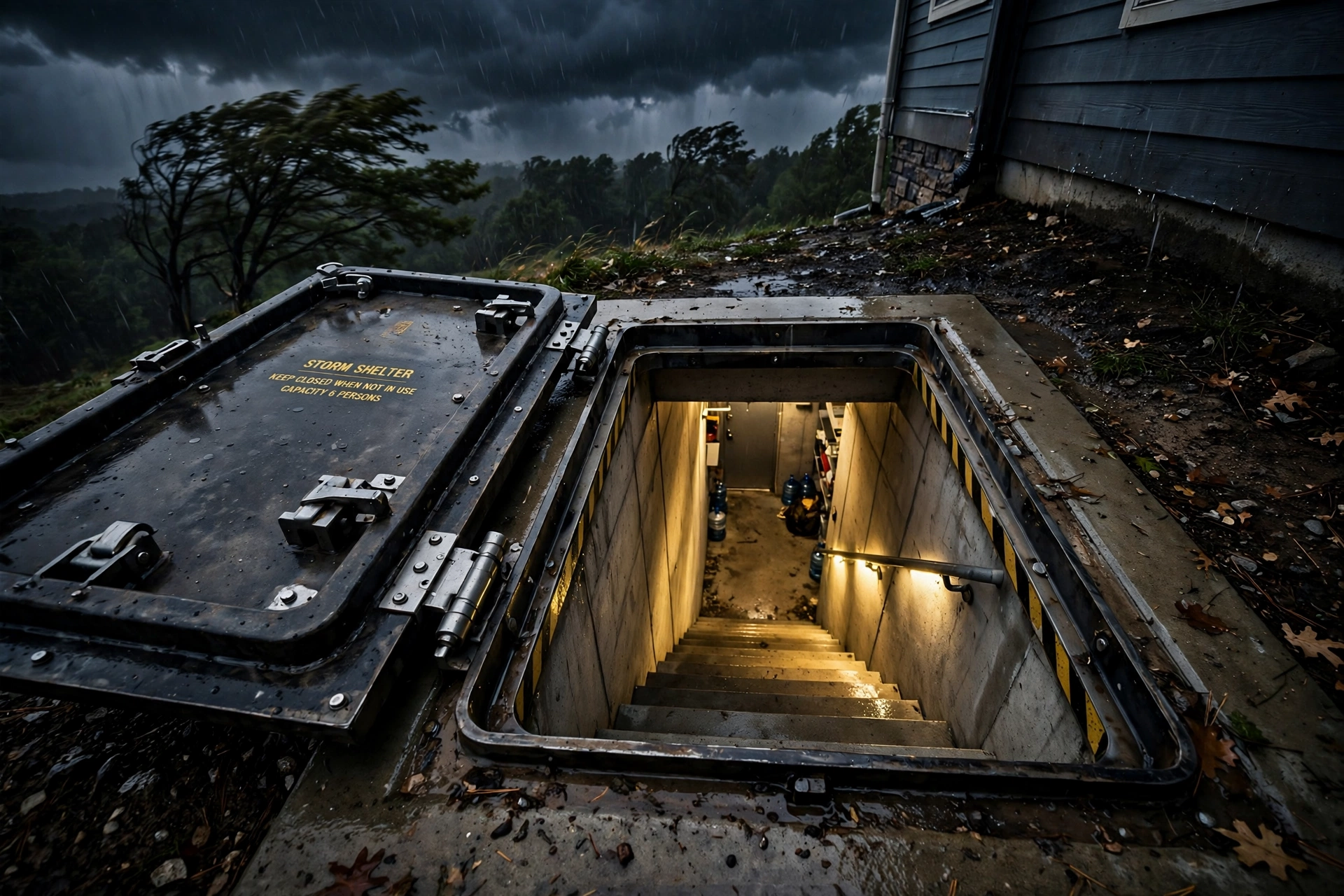
A doomsday bunker is the honest answer: a precast concrete vault buried in your own yard, stocked on your terms, ten steps from your back door. Underground, self-reliant, and yours. Not under a mattress in a bathtub. Not in a closet hoping the roof holds.
Installed across the St. Louis metro, St. Charles County, and Missouri's 573 region by the crew that does drainage and ground work for a living. A bunker is only as good as the hole it sits in. The hole is our trade.
Tornado season does not end in June. November is the peak of the second season, and Missouri sits in it.
An EF3 touched down near Clayton and crossed this metro 1.8 miles wide, the widest tornado in the region since records began in 1950. About 5,000 structures damaged, $1.6 billion in damage, 5 lives lost. It was the first deadly St. Louis tornado since 1959, and it happened here, not in some other state.
An EF5 tore through Joplin, Missouri and killed 161 people. It is the deadliest United States tornado since modern records began, and it happened in this state.
The Great St. Louis Cyclone of 1896 leveled parts of this metro in minutes. St. Louis has been hit hard before and sits in the same storm track today.
The design wind speed ICC 500 storm shelters are engineered around. EF5 winds exceed 200 mph. A closet is not a rating. Concrete and an engineered door are.
That is the warning time you actually get on a bad night. Your shelter has to be steps from your back door, in your own yard, not across town.
Most Missouri homes do not have a basement worth the name. When a cell builds over St. Charles County at 9 PM, the standard plan is a closet, a bathtub, or a neighbor's house. There is a fourth option, and it is buried in your yard before the season starts.
One Piece of Precast Concrete.
Set Once. Dry for Decades.
The shelter is a single-piece precast concrete vault, cast by an established manufacturer, delivered to your property, and set in one crane pick into a hole WB excavates, drains, and beds. No panels bolted together underground. No seams below the waterline waiting to weep. One solid structure, built for ground contact and built to stay put.
Each model is engineered and designed to meet ICC 500 storm shelter criteria, and the manufacturer's stamped plans and test documentation come with your quote, in writing, before you sign anything. Read the paper first. Then decide.
Precast concrete vault with an engineered steel door assembly, the component that decides whether a shelter holds. Manufacturer documentation provided with every quote.
Every install gets a drainage field built for your soil, waterproofing at every penetration, and a sump strategy where the water table calls for one. This is the step the brochure sellers skip.
An empty underground vault in wet Missouri ground can try to float before it is backfilled. We anchor and ballast for your water table, and backfill in lifts so the ground settles right.
A Shelter Is for Twenty Minutes.
A Bunker Is for Whatever Comes Next.
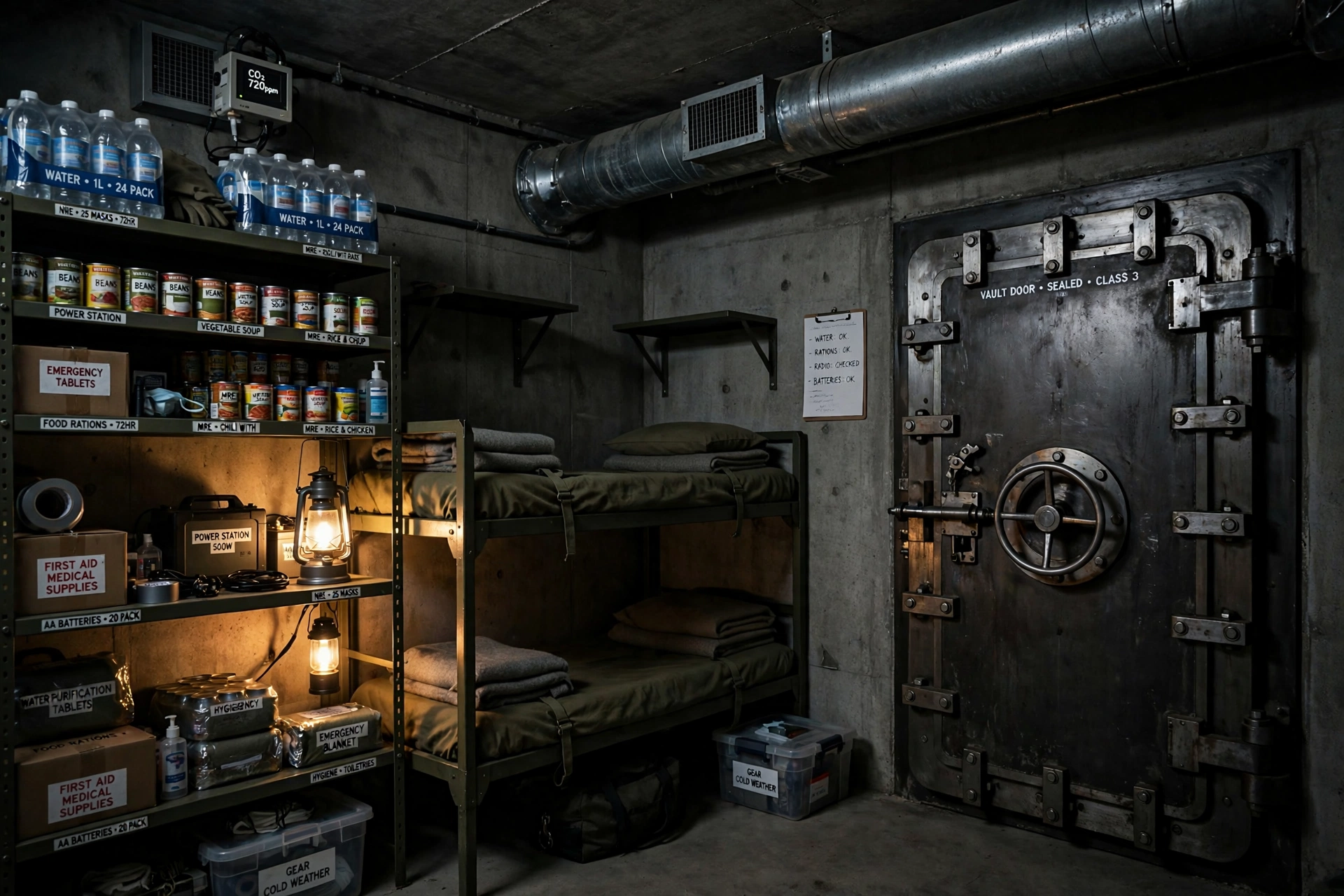
A storm shelter has one job: keep your family alive while a tornado passes overhead. It does that job in about twenty minutes, and then you climb out and it sits empty until the next siren. A bunker starts with that same job and keeps going. It is a hardened room under your own ground, stocked with your food, your water, and your gear, ready for the part nobody puts in the brochure: the days after, when the power is still out, the roads are still closed, and the store shelves are still empty.
That is the difference between reacting and being ready. The structure WB installs is built to ICC 500 storm-shelter design guidance, so the twenty minutes are covered by an engineered structure with real documentation. The bunker part is what you build inside it, at your pace, from the finish-out list: bunks and seating for the full household, shelving and storage for food, water, and gear, lighting and an electrical run from the house panel, battery backup lighting and ventilation options, and water storage. Space, storage, and power and water options you choose. Nothing promised that the structure does not actually hold.
Outages after a major storm are measured in days, not hours. Underground, the temperature holds steady, your stored water and food stay put, and battery backup options keep light and air moving while the neighborhood waits on the utility.
The time to stock a bunker is when the shelves are full, not when everyone else gets the same idea on the same day. Shelving and storage space are built into the finish-out, so what you set aside stays organized, dry, and underground.
No driving to a public shelter. No depending on a facility staying open, staffed, or reachable. Ten steps from your back door, on your property, stocked by you, for your family. Self-reliance is not a slogan here. It is a location.
A Storm Refuge Tonight.
A Stocked Bunker Over Time.
Every structure includes manufacturer-engineered ventilation, because a sealed box full of people needs fresh air by design, not by hope. Beyond that, you build the inside out at your pace. Finish-out items are separate add-ons, priced in the open, added at install or next season:
- Bunks and seating for the full household
- Shelving and storage systems for food, water, and gear
- Lighting and an electrical run from the house panel
- Battery backup lighting and ventilation options
- Water storage and safe-room style interior fittings
Nothing gets buried in the structure price. The shelter and the install are one firm written number. The inside grows when you say so.
Two Models. Installed Prices.
No Games.
Built for one job: getting your family underground when the sirens sound. Room for 6 to 8 people, the go-bags, the dog, and the documents, without taking up your whole yard.
The right fit for smaller properties, smaller households, and anyone whose honest requirement is storm safety first.
The middle ground most Missouri families land on. Room for 10 to 14 people to sit, stretch, and wait out a long storm night, with space for water, food storage, and supplies measured in weeks, not hours.
Fits most residential lots in the St. Louis metro and St. Charles County, and rural properties across the 573.
Both prices are installed starting prices covering the structure and the full WB install: site prep, excavation, drainage, set, and backfill. Starting prices assume clean digging and spoil spread on site. Rock, a high water table, haul-off, and finish-out options are priced in writing at the site check and written into your proposal before you sign. Never as mid-job surprises. Your final quote is one firm written price.
Bigger property, longer plan? Extended-stay and estate layouts scope per property after a site evaluation. Ask when you reserve.
Installed from $10,495 for the Compact and $13,250 for the Family, with your final quote in writing after a free site check. Financing runs through Acorn Finance: pre-qualify with a soft credit check that does not touch your credit score, APRs as low as 6.24%*, loans up to $100k, and no dealer fees added to your price. Check the payment before you commit to anything, then decide with real numbers in front of you.
Bunker. Safe Room. Basement Corner.
Know What Each One Actually Is.
Every homeowner in Missouri has some version of a plan. Here is what the three common options actually give you, including what the bunker does not do well. Read it straight, then decide what your family stands behind.
| The Question | The Underground Bunker (WB) | Above-Ground Safe Room | Basement Corner |
|---|---|---|---|
| Where it sits | Buried in your yard, steps from the back door, outside the house entirely. Your ground, your structure, your call. | Bolted to a slab in a garage, closet, or spare room, inside the house footprint. | Under the house itself, in whatever corner looks strongest. |
| Wind and debris | The ground itself is the shield. Wind and flying debris pass over it, and the structure is built to ICC 500 storm-shelter design guidance with an engineered door. | A rated steel room is a real structure and strong for its size, but it stands in the wind, not under it. Everything the storm throws lands on the box and the door. | No rating of any kind. A standard basement wall was built to hold up a house, not to stop debris at EF speeds. |
| If the house comes down | Your home can be destroyed above it and the bunker never knows. You climb out into the open, not out from under wreckage. | The room may hold, but the rest of the house can pile against the door. Getting out can mean waiting for help to clear you. | The worst seat in this comparison. The full weight of the house is directly overhead, and the stairs are the only way out. |
| After the storm passes | This is where the bunker separates. It is a stocked room: bunks, shelving, stored water and food, battery backup options for light and air. If the grid is down for days, your family has a place that is already provisioned. | Its job ended when the wind did. Too small to stock or stay in, it is a ride-it-out box, and a good one. It was never built to be anything after. | If the house is damaged, the basement is part of the damage. If the power is out, it is a dark room under a broken house with whatever happens to be stored in it. |
| Water | The honest downside, and the reason the installer matters. Groundwater pushes on an underground box from every side, so drainage, anchoring, and ballast decide whether it stays dry. Some properties are not candidates, and we say so at the site check. | No groundwater fight at all. Its best advantage after access. | Basements are the first room to take water in a storm flood, and they fill from the floor up while you are in them. |
| Getting in at 2 AM | A short run through the yard in the rain, down stairs with a handrail. Kids, grandparents, and dogs need a practiced drill, which we run with you at the walkthrough. | The easiest entry of the three. No rain, no stairs. The right call for anyone with real mobility limits, and we will tell you that to your face. | Indoor stairs, in the dark, often past the furnace, the water heater, and everything stored on them. |
| What it costs | Installed from $10,495. The structure plus excavation, drainage, crane set, and backfill, one firm written price after a free site check. | The unit price looks lower until slab work, delivery, and anchoring are added. Price the installed total, not the box. | Free. You get what you pay for, and on the wrong night the bill comes due all at once. |
The short version: if mobility makes a yard run unrealistic, an above-ground rated room is a legitimate answer for the storm itself and we will point you that way. If the question is bigger than one storm, if it is about your family being provisioned and self-reliant on your own ground when systems fail, that is the bunker, and it is the one this page exists to build. The site check is free, and it starts with your ground, not a pitch: Reserve a Site Check.
Six Steps. The Ground Work
Is the Whole Job.
We read your property: soil, slope, water table, equipment access, utility locations, and where the shelter sits so you can reach it fast in the dark. If your ground will not hold a dry shelter, we tell you here, not after the hole is dug.
St. Charles County requires a building permit for a storm shelter at any size. WB prepares the package: site plan plus the manufacturer's stamped anchoring drawings, and coordinates inspections through the install.
We dig the hole, build the drainage field for your soil, and bed the base. This is the step most sellers rush and most failures come from. It is the step we built our drainage business on, and we do not rush it.
The vault arrives as one piece and goes in as one piece: one crane pick, set and leveled on its bed, anchored and ballasted for your water table.
Backfill goes in lifts so the ground around the structure compacts and settles right, with waterproofing checked at every penetration before it is covered for good.
We walk the finished install with you: door operation, ventilation, drainage discharge, and your documentation package. Then we show you the drill for getting your household down there in the dark.
Why the drainage matters more than the steel: an underground box is a boat hull in reverse. Groundwater pushes on it from every side, Missouri clay holds that water against the walls, and a shelter set without a real drainage plan will sweat, seep, or try to float. The failures in this industry are almost never the structure. They are the water. WB runs drainage work across the St. Louis area every week. Already fighting water in your yard or basement? Start there: Yard Drainage and French Drains.
The Strongest Box in the World
Fails at a Weak Door.
Every engineer in this business will tell you the same thing: the door assembly is where shelters live or die. Wind does not argue with concrete. It hunts the opening. That is why the models WB installs carry engineered steel door assemblies backed by the manufacturer's impact test documentation, and why that paper comes with your quote.
The entry sits steps from your back door, set into your yard so a scared kid, a grandparent, and a dog can all make the trip at 2 AM in the rain. At the walkthrough we run the drill with your household, in the dark, until it is boring. Boring is the goal. Boring means it works when it counts.
Storm just hit instead? Emergency tarping and board-up runs at a flat $2,450, documented for your claim.
Bunker and Storm Shelter FAQs
In St. Charles County, yes, at any size. Storm shelters are carved out of the small accessory structure exemption, so even the Compact needs a building permit. The package is a site plan plus the manufacturer's anchoring drawings, with inspections during the install. WB handles the paperwork and coordination. Rural unincorporated areas in the 573 often have no county building code, but septic setbacks, floodplain rules, and an 811 utility locate still apply everywhere in Missouri.
The structure is manufactured ahead of time, so the on-site work is the excavation, drainage, set, and backfill, which runs a matter of days for most residential installs once the structure is delivered and the permit is in hand. Total timeline from contract to finished shelter depends on manufacturing lead time and permitting in your jurisdiction, and your proposal states the schedule in writing before you sign. We do not promise a start date before the structure and the crew are both confirmed.
That is the right question, and it is why the install matters more than the brochure. Groundwater gets managed three ways on a WB install: site selection at the site check (we will not set a shelter in ground that cannot be drained), a drainage field built for your soil, and anchoring, ballast, and a sump strategy where the water table is high. Some properties honestly are not candidates, and the site check is where we tell you that, before any contract.
Every structure includes manufacturer-engineered ventilation, sized for the occupancy, because a sealed box full of people needs fresh air by design. Electrical is an add-on decision: most owners run a circuit from the house panel during install (that work runs under a licensed electrician's permit), and battery backup lighting and ventilation options are on the finish-out list. Generator hookups and larger off-grid setups scope at the site check, since the right answer depends on how long you plan to stay underground.
Yes. Financing runs through Acorn Finance with a soft credit check: no impact to your credit score, APRs as low as 6.24%*, loans up to $100k, and no dealer fees. You can also build in stages: the structure and install as one project, finish-out options added later as budget allows. Check Acorn pre-qualification.
The St. Louis metro, all of St. Charles County, and Missouri's 573 region. WB Exterior Solutions is based in St. Peters, MO. Rural properties with acreage are welcome and often the easiest installs. Tight suburban lots get the same site check, and if access or easements block a safe install, we say so at the site check.
The Bunker Is One Piece
of a Ready Property.
Preparedness is not one purchase. It is the roof over the house, the water moving away from the foundation, the shop that holds the equipment, and knowing what the sky is doing before it does it. WB builds all of it. Start wherever your property is weakest.
The WB Weather Watch page is a daily-use local weather page for St. Charles County: live radar, active alerts, and the forecast that decides whether tonight is a bunker night. Check it every morning, not just in storm season.
Open Weather WatchTarping, board-up, and storm damage response, documented for your insurance claim. If you are reading this page after the fact instead of before it, this is your door.
Storm ResponseRoof, siding, gutters, deck: get a satellite-measured estimate on the rest of the property in about a minute, with market pricing for your state. A ready property starts with knowing the numbers.
Run the Instant EstimateRural ground with a plan: a post frame shop for the equipment, the vehicles, and the work, with the bunker set into the same property. One site check scopes both. This is the package most acreage owners end up describing to us.
Post Frame BuildingsAnd the shortest path through all of it is still the first one: the site check reads your ground for the bunker and your property for everything above it, in one visit, with firm written numbers. Reserve a Site Check.
Storm Season Does Not Wait.
Neither Does the Build Queue.
Every bunker project starts the same way: a look at your property, an honest read on your soil and water, and a firm written price for the structure that fits it. No pressure, no obligation to build, and no numbers invented before we have seen your ground.
WB Contracting LLC dba WB Exterior Solutions LLC | St. Peters, MO | (636) 874-8808
let’s build Something
great together

Helping Home Owners To Realize Their True Homes Potential And Value!
Email: [email protected]
Phone: (636) 874-8808

Business hours
Monday: 9am to 5pm
Tuesday: 9am to 5pm
wednesday: 9am to 5pm
Thursday: 9am to 5pm
friday: 9am to 5pm
© Copyright 2026. WB Exterior Solutions. All rights reserved.